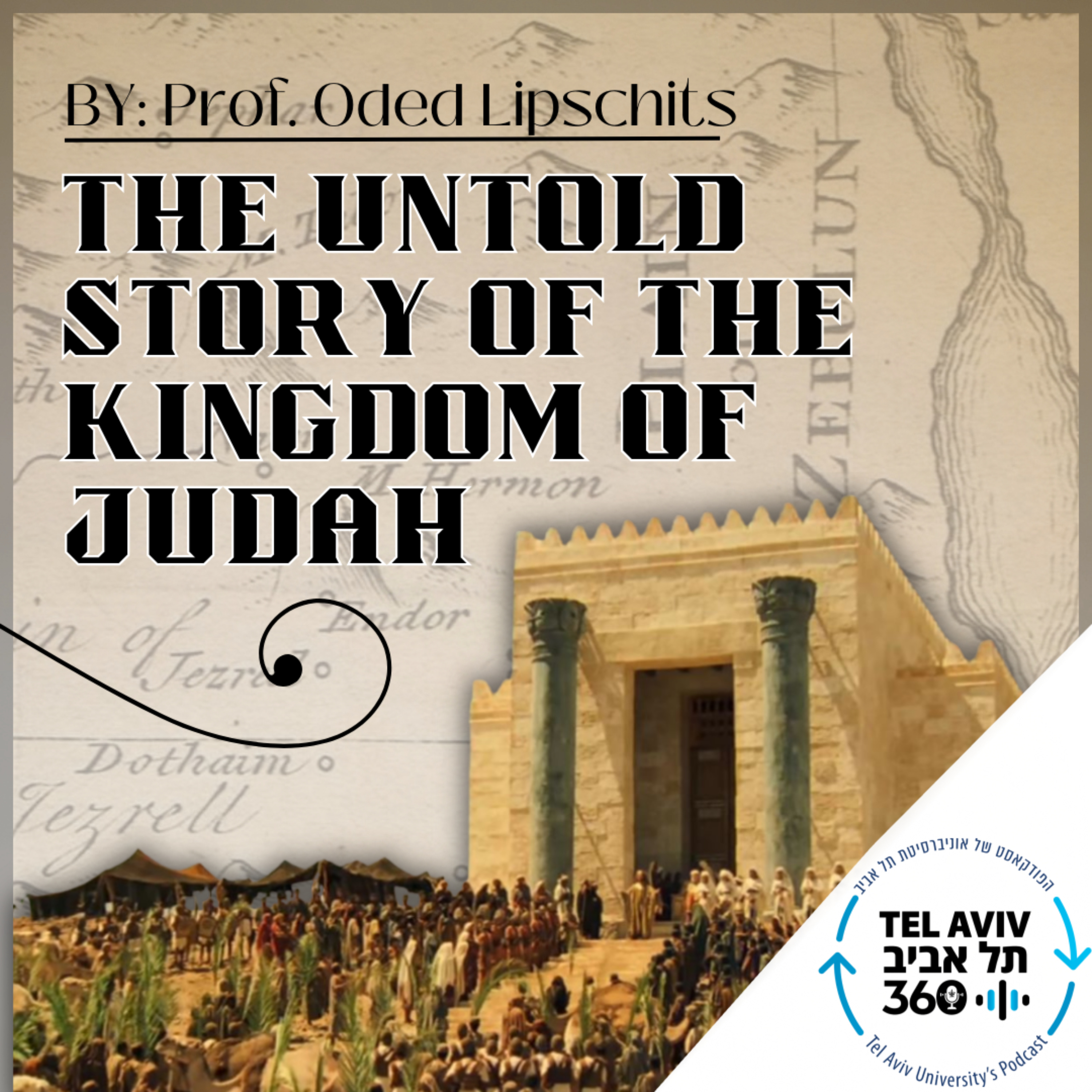
The Untold Story of the Kingdom of Judah | Tel Aviv 360
הפודקאסט חושף את הסיפור שלא סופר על ממלכת יהודה, כפי שמתואר בתנ"ך. פרופ' עודד ליפשיץ בוחן את ההיסטוריה המקראית מנקודת מבט ביקורתית, תוך שימוש בממצאים ארכאולוגיים ובקריאה ביקורתית של הטקסט. הוא מנסה להבין מה השמיטו מחברי ההיסטוריה המקראית ומדוע, ומציע פרשנות חלופית לאירועים.
פרקים
(E8) The Untold Story of Jeremiah the Prophet
Jeremiah was not one of the popular figures in Jerusalem on the eve of the Temple’s destruction. The ideology he held was contrary to that of many of the ministers and public leaders who championed the rebellion in Babylon and believed in the divine protection over the city, the temple and the dynasty of the House of David who were chosen by God and were given the eternal promise. This was also th
(E7) The Untold Story of King Josiah
From the biblical historiographer’s point of view, Josiah was the greatest of the kings who reigned in Judah. The reform carried out in his time in the spirit of Deuteronomy, during which the cult in Judah was purified and concentrated in Jerusalem, is the measure by which, looking back, all the other kings in Judah were judged. The days of his reign can be dated to the years 640-609 BCE. However,
(E6) The Untold Story of King Manasseh
This chapter deals with the most untold story about one of the kings of Judah. King Manasseh reigned longer than any of the other kings of Judah, he was the son of Hezekiah and the grandfather of Josiah, and during his long reign Judah recovered from the severe blow inflicted on it by Sennacherib’s campaign. Judah was integrated into the Assyrian Empire which was at the height of its power and str
(E5) The Untold Story of Sennacherib’s Campaign and the Fate of Jerusalem
Sennacherib’s campaign against the Kingdom of Judah, held in 701 BCE, was the most dramatic and significant event in the history of the Kingdom of Judah until the Babylonian destruction that came 115 years later. It left in its wake clear and well-dated layers of destruction, and resulted in severe damage to Judah, the exile of many residents, the destruction of the economy, and the lowlands’ sepa
(E4) The Untold Story of the “Temple of Solomon” at Tel Moza
The Untold Story of the Kingdom of JudahOded LipschitsPart E. The Untold Story about the Kingdom of Judah in the Days of the Biblical HistoriographersThe accidental and exciting discovery of a temple that existed and operated throughout the days of the First Temple, at a distance of only seven kilometers from Jerusalem, allows a unique and one-time glimpse, at least for now, of the way in which te
(E3) The Untold Story about the Magnificent Structures Near Jerusalem
The Untold Story of the Kingdom of JudahOded LipschitsPart E. The Untold Story about the Kingdom of Judah in the Days of the Biblical HistoriographersIn the century in which Judah was under Assyrian rule (from 732 to slightly after 630 BCE) it is possible to notice a considerable increase in the importance of the areas surrounding Jerusalem to the north, west and south, which became more central t
(E2) The Untold Story of Judah’s Enslavement to Assyria
The Untold Story of the Kingdom of JudahOded LipschitsPart E. The Untold Story about the Kingdom of Judah in the Days of the Biblical King Ahaz came to power at the time when the Syro-Ephraimite alliance was formed, and it can be assumed that Rezin, King of Damascus, and Pekah, King of Israel, attacked Judah immediately upon his ascension to the throne, in order to take advantage of the fact that
(E1) The Untold Story of the Hundred Years of Assyrian Rule in Judah
The Untold Story of the Kingdom of JudahOded LipschitsPart E. The Untold Story about the Kingdom of Judah in the Days of the Biblical HistoriographersThis chapter deals with the untold story of the history of the kingdom of Judah in the days of the authors of the Biblical history, with the aim of examining why they ignored the strict Assyrian rule in Judah from the time of the enslavement to Assyr
(D11) The Untold Story of the Last Days of the Kingdom of Israel
The Untold Story of the Kingdom of JudahOded LipschitsPart D: Part Four: The Untold Story of the History of the Kingdom of IsraelThe account of the history of the Kingdom of Israel in the last generation of its existence, starting from the short reign of Zechariah, the son of Jeroboam II (746 BCE) until the destruction of the Kingdom (722 BCE), is a short, dry and focused account, which tells main
(D10) The Untold Story of the Kingdom of Israel under Jeroboam II
The Untold Story of the Kingdom of JudahOded LipschitsPart D: Part Four: The Untold Story of the History of the Kingdom of IsraelJeroboam II was one of the greatest kings who reigned in Israel, and during his time the kingdom reached, for the last time in its history, the peak of its expansion and wealth, and this just a single generation before its rapid collapse, destruction and exile. During th
(D9) The Story about Joash that Was Told, but Not in the Right Place
Joash the king of Israel was marked in the eyes of the Judean scribes, because he was the only one of the kings of Israel who captured the king of Judah on the battlefield, who conquered a city in Judah and destroyed parts of the wall of Jerusalem. Despite the information the historiographer had about Joash’s successes, as someone who was close to the prophet Elisha, as someone in whose days Israe
(D8) The Untold Story of the Historical Reality in Elisha’s Stories
The description of the major low point in Israel’s history during the reigns of Jehu and his son Joahaz was interwoven with the set of stories about the prophet Elisha, and few of the long chapters taken from the prophetic stories refer to the geopolitical reality that existed in Israel during this period of time. It seems that apart from the basic information that the biblical historiographers ha
(D7) What was Told and What was Left Untold about Jehu’s Rebellion
The dramatic events of the year 842 BCE had tremendous consequences for Damascus, Israel and Judah, as they were also the beginning of a new and different era: in Damascus, Hazael had ascended to the throne in a rebellion against Hadadezer, in Israel Jehu ascended to the throne, and destroyed the Omride Dynasty in a violent rebellion, which also included the elimination of many members of the Jeru
(D6) The Untold Story about the Greatness of the Kingdom of Omri and Ahab
At the beginning of the ninth century BCE, the Kingdom of Israel first appeared on the stage of history. Even without the biblical description of the days of the Omride kings, we could reconstruct the history of this dynasty and its greatness and power, since the archaeological findings and inscriptions found from that time period indicate a sharp change that took place in the kingdom’s urban cult
(D5) Lists of Kings and Memories of Murders, Rebellions and Dynasties
In this chapter of the podcast, I examine the stories about the first kings of Israel and the royal houses that rose and fell in Israel before the establishment of the Omride Dynasty in the early ninth century BCE: the house of Jeroboam, the house of Baasha and King Zimri, who reigned over Israel for only a few days until he was murdered by Omri, who founded a dynasty that succeeded for the first
(D4) The story that was Told of the Kings of Israel and Judah
The editorial framework of the Book of Kings is based on synchronisms – the matching of time periods between the reigns of the kings of Israel and the reigns of the kings of Judah. Synchronizing the history of the kings is done using opening formulae and closing formulae for each king. Through this synchronicity and the use of the opening and closing formulae, the descriptions of the history of th
(D3) The Untold Story about Why Saul went to War against Nahash the Ammonite
In this chapter of the podcast, I argue that the main reason why the people sought to appoint Saul as king was omitted from the Biblical description in the book of Samuel, and the short text that was omitted was preserved in a scroll discovered in a cave in Qumran, near the Dead Sea. In order to substantiate this claim, I give a brief introduction to the composition and content of the Book of Samu
(D2) The Untold Story about Deborah, Barak, and Jael’s Victory
Chapter 4 in the Book of Judges describes the miraculous victory of Deborah, Barak and Yael over Jabin, the king of Canaan, and Sisera, the commander of his army at Harosheth Haggoyim (חֲרֹ֥שֶׁת־הַגּוֹיִֽם; Harosheth of the Nations). This story is special not only in its content and because of the female characters who play a lead role in it, but also because it is followed, in Chapter 5, by the S
(D1) The Untold Story of How the Book of Saviors Became the Book of Judges
This chapter examines the process of “Judaization” applied to the Israeli book of the Saviors and its transformation into a Deuteronomistic Judean text, which could be integrated into the general historiographical system. This, as a background for examining the original information contained in this book and the question of what the Jerusalemite historiographers knew about the early history of the
(C4) The Untold Story of the Shephelah in Sennacherib’s campaign
Towards the end of the eighth century BCE, Judah was at the peak of its development as a mature and developed kingdom. It was based on a fairly dense hierarchy of settlements, which was spread throughout all parts of the kingdom, and included farms, villages, secondary settlements and central towns. The lowlands were the most populated and fertile region of the kingdom, and Lachish served as the s
(C3) The Untold Story of Moreshet-Gath
Azekah’s power and wealth, the strong fortifications from the Middle Bronze Age, the extent of the city’s borders in the Late Bronze Age and the wealth of finds that were discovered, the strategic location and the control of the main roads connecting the hill country in the east and the coastal area in the west, together with the rich agricultural potential of the Elah Valley, all of these allowed
(C2) The Untold Story of the Elah Valley Clan
Part C: The Untold Stories of the Lowlands and its HistoryIn this chapter I argue that the “Elah Valley Clan” lived and existed on its land for 1100 years, starting from the beginning of the Middle Bronze Age I, around 1800 BCE, until the destruction by Sennacherib, King of Assyria in 701 BCE. For most of this long period, this tribe was active in the geopolitical space of the local lowlands citie
(C1) The Untold Story of the Lowlands and the Tribe of Judah
Part C: The Untold Stories of the Lowlands and its HistoryAt the end of the 7th century BCE, after the Assyrian withdrawal from the area west of the Euphrates, Judah established its renewed hold on the lowlands, which became an integral part of the kingdom’s territories, and an important component of its economy. In the light of this reality, the history of the lowlands was described since the day
(B5) The Untold Story of Temple's Renovation and the Altar Replacement
Part B: The Untold Stories of Ancient JerusalemOver the centuries of Judah’s existence, the temple in Jerusalem gradually became the focus of the people’s life. However, it is doubtful whether the Jerusalem historiographers had reliable written sources of information about the past of the temple and its history. It was easy for them to describe its construction, since the temple built by Solomon c
(B4) The Untold Story of Shishak’s Campaign and Jerusalem’s Role in It
Part B: The Untold Stories of Ancient JerusalemThe military campaign conducted by Shishak in the Land of Israel is the earliest historical event described in the Hebrew Bible (1 Kings 14: 25-28; 2 Chronicles 12: 2-12), and which is also explicitly mentioned in an extra-biblical source: the list of the places conquered during the campaign was engraved on one of the walls at the entrance to the Temp
(B3) The Untold Story of David’s Conquest of Jerusalem
Part B: The Untold Stories of Ancient JerusalemThe only memory that exists of the founding event in the history of the Kingdom of Judah, when King David conquered Jerusalem, made it his capital and founded the dynasty and the kingdom, was of the involvement of the “blind and the lame,” and that anyone who struck them had to be purified. In this chapter, I argue that the source of the story’s memor
(B2) The Untold Story of the History of Jerusalem Before its Conquest under David
Part B: The Untold Stories of Ancient JerusalemMemory-bearing objects, places and buildings are permanent elements in changing demographic, political and religious landscapes, whose memory is rooted in their very existence, and the interpretation, understanding and use of memory changes according to the needs and desires of each generation. The existence of memory-bearing objects, buildings and pl
(B1) What was Left Untold about Ancient Jerusalem
Part B: The Untold Stories of Ancient JerusalemMany details about Jerusalem were left untold by the authors of ancient history simply because they were clear and obvious to both the authors and the readers of these accounts. Some of these details are also known to us, but some are no longer. The biblical story was written by Jerusalemscribes who lived in Jerusalem and their descriptions were writt
(A6) The Untold Story of the Conquest of the Land
Part A: Introductory chaptersThe book of Joshua continues the book of Deuteronomy, and is connected to it historically, conceptually and narratively and also by its Deuteronomistic ideology. Despite this connection, and despite the clear continuity between the two books, Joshua is the first of the “Former Prophets” books in the Hebrew Bible. This is the introduction for the historiographic descrip
(A5) "Israel" in the Hebrew Bible and the "History of Israel"
Part A: Introductory chaptersThere are large gaps between the “Israel” described in the Hebrew Bible, the “Israel” that can be reconstructed by following the archaeological evidence, and the “Israel” that appears in written sources other than Biblical historiography. Comparing the “Israel” described in the Hebrew Bible (the figure of Jacob/Israel, his sons who are “The Children of Israel,” from wh
(A4) When was the Biblical Historiography Written? Which Ideas Guided its Writing?
Part A: Introductory chaptersThe biblical historiography began to be written in the days of Josiah, several decades before the destruction of the First Temple, in order to explain to the readers in Jerusalem of that time period how they should understand the past and learn from it about the reality of their day, and the way they should behave in the future. The destruction of Jerusalem and the tem
(A3) The Time and Purpose of the Book of Deuteronomy and the Deuteronomistic Ideology
Part A: Introductory chaptersThe connection between the book of Deuteronomy and the cult reform of the days of Josiah is the most important chronological and historical anchor point within biblical research, and is also the ‘heart of the consensus’ among most scholars. This connection explains the ideology of the authors of the biblical historiography as well as the time when the historical accoun
(A2) History, Historiography, and the Biblical Text
Part A: Introductory chaptersThe historians who composed the ancient historiographical work, which is found today in the ancient core of the books of Joshua, Judges, Samuel and Kings, reflected their worldview in it. They aimed not to tell the history of Judah (or of Israel and Judah), but to explain the historical progression, the overall situation, and the reasons why Judah and Jerusalem were wh
(A1) Introductory chapters, Introduction
Part A: Introductory chaptersThe biblical story of the history of the Kingdom of Judah, as told in the books of Joshua, Judges, Samuel and Kings, describes the point of view of the Jerusalem elite: what it knew, what it wanted to tell and what served its political, religious and economic interests. In this podcast I we will try to find out what the authors of biblical history didn't tell.First
מומלץ

חוץ לארץ

בזמן שעבדתם

اصل الحكاية – راديو الرابعة 107.8 FM

מוזגים עם גובי ושמנדריק

קקטוס הזהב - הפודקאסט

סינמה שו"ת | פודקאסט הקולנוע של סרוגים

קול הדור | פודקאסט שבועי אקטואלי עם הרב אברהם סתיו, תהילה פרידמן ורונ

מחוץ לפריים | רן בוקר

MTVA Podcast

Cabalá: Lecciones Diarias | mp3 #kab_spa

News In Easy Hebrew

הוטפיקס | HOTFIX