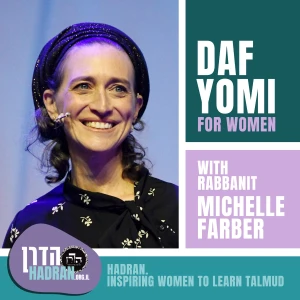
Daf Yomi for Women - Hadran
Hadran.org.il is a portal for Daf Yomi studies designed specifically for women, offering daily Talmud classes taught by a woman. The podcast is led by Rabbanit Michelle Cohen Farber, a graduate of Midreshet Lindenbaum's scholars program, who teaches from Israel. Each morning's daf yomi class is delivered via ZOOM and then uploaded for podcast and download. The initiative aims to provide women around the world with access to a woman's perspective on central Jewish texts and to advance women's Torah study.
פרקים
Bekhorot 39 - October 27, 16 Cheshvan
Study Guide
Bekhorot 38 - October 26, 15 Cheshvan
Bekhorot 37 - October 25, 14 Cheshvan
Bekhorot 36 - Shabbat October 24, 13 Cheshvan
Bekhorot 35 - October 23, 12 Cheshvan
Study Guide
Bekhorot 34 - October 22, 11 Cheshvan
Bekhorot 33 - October 21, 10 Cheshvan
Study Guide
Bekhorot 32 - October 20, 9 Cheshvan
Bekhorot 31 - October 19, 8 Cheshvan
Bekhorot 30 - October 18, 7 Cheshvan
Bekhorot 29 - Shabbat October 17, 6 Cheshvan
Bekhorot 28 - October 16, 5 Cheshvan
Study Guide
Bekhorot 27 - October 15, 4 Cheshvan
The braita states that an owner retains financial benefit (tovat hana'a) for priestly gifts, permitting an Israelite to accept payment from a fellow Israelite to direct teruma to a specific kohen who is a relative, whereas a kohen may not pay another kohen for it. The Gemara asks why the braita specifies teruma rather than other priestly gifts (matnot kehuna). It answers that teruma possesses intr
Bekhorot 26 - October 14, 3 Cheshvan
Bekhorot 25 - October 13, 2 Cheshvan
Bekhorot 24 - Rosh Chodesh Cheshvan - October 12, 1 Cheshvan
Bekhorot 23 (Full Episode) - October 11, 30 Tishrei
Bekhorot 22 - Shabbat October 10, 29 Tishrei
Bekhorot 21 - October 9, 28 Tishrei
Bekhorot 20 - October 8, 27 Tishrei
Study Guide A braita presents opinions regarding an animal purchased from a non-Jew whose birthing history is unknown. Rabbi Yishmael establishes age-based presumptions (that a goat in its first year, a sheep in its second, and a cow or donkey in its third is assumed to have not yet produced a firstborn prior to the sale), while Rabbi Yosi bar Rabbi Yehuda requires four years for a donkey. Rabbi
Bekhorot 19 - October 7, 26 Tishrei
Bekhorot 18 - October 6, 25 Tishrei
Study Guide
Bekhorot 17 - October 5, 24 Tishrei
The Gemara continues to analyze the dispute between Rav Huna and Rav Yehuda regarding the offspring generations of guaranteed livestock (tzon barzel) that one received from a non-Jew. It evaluates their views against the ruling of Rabban Shimon ben Gamliel in the Mishna and against the statement of the tanna kamma in the first clause (reisha) of the Mishna, demonstrating how each Amora reinterpret
Bekhorot 16 - October 4, 23 Tishrei
The Gemara analyzes the braita brought to support Rav Sheshet's position that the fetus of a sanctified animal that became blemished can be redeemed (i.e., designated before the mother is redeemed to be used for the same sacrifice as its mother). First, the Gemara explains what can be derived from the concluding line in each section of the braita, "this is the general rule" (klalo shel davar). The
Bekhorot 15 - Shabbat Shemini Atzeret - October 3, 22 Tishrei
Study Guide
Bekhorot 14 - Hoshana Rabba - October 2 , 21 Tishrei
Bekhorot 13 - October 1, 20 Tishrei
Study Guide The Gemara discusses a contradiction regarding the time for redeeming a firstborn donkey (peter chamor). One braita states that is can be done immediately, while another states that it cannot be performed before thirty days. Three resolutions are brought. Rav Nachman explains that if one redeemed it within thirty days, it is redeemed post-facto (b'dieved). Rav Sheshet suggests that th
Bekhorot 12 - September 30, 19 Tishrei
The Mishna lists animals that cannot be used for redemption, including a calf, an undomesticated animal, a slaughtered or treifa animal, a hybrid (kilayim), or a koy (a creature of doubtful status between a domesticated and undomesticated animal). Rabbi Eliezer permits redemption using a hybrid because it is nevertheless a lamb (born to two animals in the sheep family), but forbids a koy. The Gema
Bekhorot 11 - September 29, 18 Tishrei
How much must one give to redeem a firstborn donkey? Rabbi Yosi bar Yehuda requires at least one shekel, whereas the Sages hold that any minimal amount is valid for redemption. Rav Yosef explained that the value of "any minimal amount" can even be a lamb worth a sixth of a zuz. However, in the story involving Rabbi Yehuda Nesia, Rabbi Tarfon presents three options—a generous eye, a stingy eye, and
Bekhorot 10 - September 28, 17 Tishrei
Even though Rabbi Shimon and Rabbi Yehuda disagree regarding whether a firstborn donkey (peter chamor) is forbidden for benefit, Rabba maintains that Rabbi Shimon, who permits benefit prior to redemption, agrees that if the donkey was not redeemed and its neck was broken, it becomes forbidden for benefit. Rabba derives this law via a gezeira shava comparing the term "breaking the neck" (arifah) us
Bekhorot 9 - September 27, 16 Tishrei
Bekhorot 8 - Shabbat, 1st Day of Sukkot - September 26, 15 Tishrei
Bekhorot 7 - September 25, 14 Tishrei
Does Rabbi Shimon require an offspring to resemble its mother in its head and most of its body (ראשו ורובו) to be permitted for consumption, or does his requirement of its head and most of its body apply exclusively to firstborn (bekhorah) status? Three braitot are brought to answer this question, but all are deemed inconclusive. Is donkey urine permitted or forbidden? While horse and camel urin
Bekhorot 6 - September 24, 13 Tishrei
Following the dispute between the tanna of our Mishna and Rabbi Yosi HaGelili, where each derived from a different verse the exemption from firstborn status for an animal that gave birth to an offspring resembling a different species, the Gemara clarifies what Rabbi Yosi HaGelili derives from the proof-verses of our tanna ("peter hamor" twice). Rabbi Yosi HaGelili derives from there the source for
Bekhorot 5 - September 23, 12 Tishrei
The Gemara continues analyzing the dispute regarding whether firstborns were sanctified in the desert. According to Reish Lakish, they were not sanctified until entering the Land, whereas Rabbi Yochanan holds they were already sanctified in the wilderness. Rabbi Eleazar explains that Rabbi Yochanan derived his position from the verse "לי יהיו" ("they shall be Mine") – b'havayatan yehu, meaning tha
Bekhorot 4 - September 22, 11 Tishrei
The Mishna rules that Kohanim and Levites are exempt from bekhora (firstborn male donkeys) based on a kal v'chomer: if they exempted the firstborns of Israelites in the desert, logic dictates that they exempt their own. The Gemara challenges the Mishna's premise as the Levites themselves did not exempt the donkeys of the Israelites – they themselves exempted the Israelite firstborn males, and thei
Bekhorot 3 - Yom Kippur - September 21, 10 Tishrei
Bekhorot 2 - September 20, 9 Tishrei
The Mishna rules that if a Jew buys a donkey embryo from a non-Jew, sells one to him, enters into a partnership with him, or receives or gives an animal under a sharecropping agreement (kablanut), the offspring is exempt from bekhora. The Gemara questions why the Mishna needs to enumerate all these individual cases, and explains that each is necessary: selling must be taught so we do not fine a Je
Introduction to Masechet Bekhorot with Dr. Ayelet Hoffman Libson
Introduction to Masechet Bekhorot
Chullin 142 - Siyum Masechet Chullin - Shabbat September 19, 8 Tishrei
Hadran Ceremony Text
Chullin 141 - September 18, 7 Tishrei
Chullin 140 - September 17, 6 Tishrei
Study Guide The Gemara explains that the word "tzipor" includes only kosher birds, excluding non-kosher birds from the commandment of shiluch haken. Four additional verses are brought (supplementing the four from Chullin 139) in an attempt to disprove this premise. However, each verse is explained in a different manner, demonstrating that "tzipor" indeed refers exclusively to kosher birds. If the
Chullin 139 - September 16, 5 Tishrei
Ravina derives from "shaleach teshalach" that a kosher bird that killed a human, before it is convicted, it is exempt from shiluach haken because one is commanded to bring it to court rather than send it away. The Mishna ruled that consecrated birds are exempt from the mitzva of shiluach haken. The Gemara attempts to find a case of sanctified birds that would require an exemption. After four faile
Chullin 138 - September 15, 4 Tishrei
Reconciling Rav's two rulings on the required fleece yield, where he states "a mane and a half" (mane v'pras) in one context and "sixty" in another, the Gemara explains that Rav refers to a mane of forty sela'im, making a mane and a half equal to sixty sela'im. Regarding the five-sela'im gift, a braita clarifies that the owner is not required to bleach the wool before giving it; rather, he must pr
Chullin 137 - September 14, 3 Tishrei
Study Guide The obligation of reshit ha'gez (first shearing) applies exclusively to sheep. Although the Gemara initially suggests a gezeira shava comparing "gez" in Deuteronomy 18:5 to Job 31:20 ("m'gez kvasai yitchamam"), it ultimately derives the requirement from the phrase "l'amod l'sharet", establishing that the material must be fit for priestly service. This excludes goat hair - which is use
Chullin 136 - 2nd Day of Rosh Hashana - September 13, 2 Tishrei
Study Guide
Chullin 135 - 1st Day of Rosh Hashana - September 12, 1 Tishrei
Chullin 134 - September 11, 29 Elul
Chullin 133 - September 10, 28 Elul
Rav Chisda's requirement for complete mastery of all twenty-four priestly gifts is rejected based on Rabbi Simeon's standard: any kohen who acknowledges the validity of the Temple service (modeh b'avoda) is eligible to receive gifts. Deriving from "v'natan" ("and he shall give"), kohanim are forbidden from grabbing gifts, prompting Abaye to outline his personal practice that developed from seizing
Chullin 132 - September 9, 27 Elul
The eligibility of a Kohen's daughter (kohenet) to receive priestly gifts (matanot) is disputed between Rava (forbidding) and Ulla (permitting), reflecting a broader Tannaitic disagreement between the academy of Rabbi Yishmael (excluding a kohenet) and the academy of Rabbi Eliezer ben Yaakov (including her). Following common practice where several amoraim received and ate matanot on account of
Chullin 131 - September 8, 26 Elul
Rav Chisda rules that anyone who destroys or eats priestly gifts (zero'a, lechayayim, keva) prior to distribution is exempt from financial restitution, whether derived from the word "zeh" in the verse or because these gifts constitute property with no specific claimant (mamon she-ein lo tove'in). The Gemara raises seven challenges from various Tannaitic sources (including rulings on other priestly
Chullin 130 - September 7, 25 Elul
The Mishna rules that the priestly gifts of the foreleg, cheeks, and abomasum (zeroa, lechayayim, v'keiva) apply both in the Land of Israel and abroad, during the Temple period and after its destruction, regarding non-sacred animals (chullin), but not consecrated animals (mukdashin). Although a logical inference (kal v'chomer) suggests consecrated animals should require gifts since they require th
Chullin 129 - September 6, 24 Elul
A braita rules that if one cuts an olive-bulk of flesh from a limb attached to a living animal, designating it for food only after cutting renders it pure, whereas designating it prior to cutting renders it susceptible to food impurity, as it touches the limb (which has high level impurity) as it is being cut. The Gemara presents Rav Asi's challenge to Rabbi Zeira as to why prior designation cause
Chullin 128 - Shabbat September 5, 23 Elul
Chullin 127 - September 4, 22 Elul
A braita discusses whether a sea-mouse transmits impurity—that is, whether the word "mouse" includes a sea-mouse. Within that discussion, it also addresses a mouse that is half flesh and half earth, deriving from scripture that it transmits impurity like a standard mouse. The braita concludes that a sea-mouse does not transmit impurity. The Gemara raises two challenges against the braita, but reso
Chullin 126 - September 3, 21 Elul
The Gemara continues analyzing Rava's attempt to prove that "touch" (maga) can include tent-impurity (ohel) based on Rabbi Yosi's ruling regarding bed frames and window bars. Abaye rejects this proof, explaining that the case involves a space under a handbreadth (tefach), and due to a challenge raised against his explanation, Abaye is forced to explain that Rabbi Yosi holds concealed impurity does
Chullin 125 - September 2, 20 Elul
The Mishna distinguishes between the marrow-bones (kulit) of a corpse or consecrated sacrifices of pigul and notar (kodashim) and those of a carcass (neveila) or a creeping creature (sheretz). Touching a corpse or sacrificial marrow-bone imparts impurity whether sealed or perforated, whereas a neveila or sheretz marrow-bone imparts impurity through touch (maga) and carrying (masa) only if perforat
Chullin 124 - September 1, 19 Elul
Chullin 123 - August 31, 18 Elul
Rabbi Avahu cited in the name of Reish Lakish three situations where the measurement of walking four milin applies in halakha: traveling to find pure vessels for making dough, a minyan (or water for washing hands before prayer), and water for washing before eating bread. Rav Nachman bar Yitzchak corrects this statement on two counts: first, it was stated by Aivu, not Rabbi Avahu; second, it appl
Chullin 122 - August 30, 17 Elul
Chullin 121 - Shabbat August 29, 16 Elul
Chullin 120 - August 28, 15 Elul
Chullin 119 - August 27, 14 Elul
Chullin 118 - August 26, 13 Elul
Study Guide
Chullin 117 - August 25, 12 Elul
Chullin 116 - August 24, 11 Elul
Chullin 115 - August 23, 10 Elul
Chullin 114 - Shabbat August 22, 9 Elul
Chullin 113 - August 21, 8 Elul
Chullin 112 - August 20, 7 Elul
Chullin 111 - August 19, 6 Elul
Chullin 110 - August 18, 5 Elul
Chullin 109 - August 17, 4 Elul
Chullin 108 - August 16, 3 Elul
Chullin 107 - Shabbat August 15, 2 Elul
Chullin 106 - 2nd Day of Rosh Chodesh Elul - August 14, 1 Elul
Chullin 105 - 1st Day of Rosh Chodesh Elul - August 13, 30 Av
Chullin 104 - August 12, 29 Av
Chullin 103 - August 11, 28 Av
Study Guide
Chullin 102 - August 10, 27 Av